Restoring the public sector as a vocation
Amelia Wood, Labour Together
Strikes by unhappy trainee doctors have become something of a feature of the health service in recent years – resident doctors have walked out 15 times since 2023, with more to follow. The BMA, the doctors’ union, warns of monthly strikes until August.
Doctors have not historically been fond of the picket line. Before resident doctors downed stethoscopes over changes to their salaries under the Tories in 2015, there hadn’t been a national doctors strike in 40 years. Since then there have been 20.
Despite big pay bumps by the Labour government, getting real back pay back very close to what it was last time Labour was in power, resident doctors remain unwilling to ditch the placards.
It may be tempting to bung any spare budget into further pay rises. But resident doctors’ salaries are already pretty good. Accounting for overtime, resident doctors can now expect to earn £46,000 in their first year of work, and £77,000 in year five. Starters in the 1980s NHS earnt less than the average worker, not 20% more.
Method to the madness?
The regular ructions of resident doctors are a microcosm of the broader, yet more subtle damage austerity wrought on public services. Cuts to prisons and policing make the treatment of resident doctors look positively sweet. The Coalition government swiftly slashed starting salaries of prison and police officers by a fifth. It took a decade for real salaries to mostly recover (see chart). In the meantime, 20,000 fewer police officers departed. The prison workforce fell by a third.
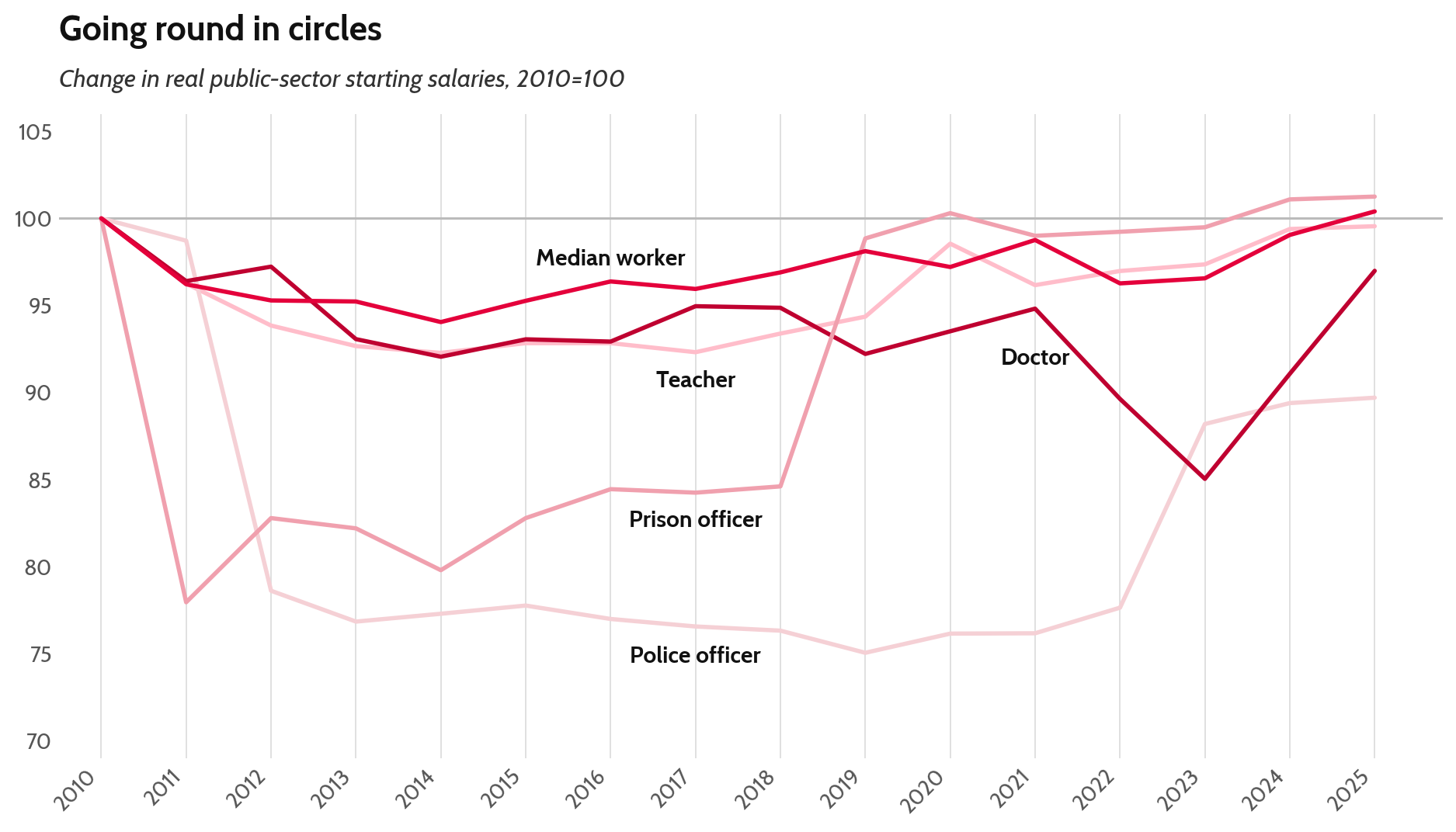
There was of course a method to the madness: the Conservatives felt that the public sector was bloated and needed to be trimmed back. But lacking a clear picture of exactly what the public sector ought to do less of, the inevitably blunt cuts to staffing and salaries served to cut performance rather than waste.
The Tories learnt the error of their ways in office. They fought the 2019 election on a pledge to hire 20,000 additional police officers (sound familiar?). Prison officer pay was hiked back up when recruitment dwindled, and it became clear the nation’s prisons were on the verge of crisis.
But the damage had been done. It was the experienced hands who departed during the austerity years. On a spreadsheet everything appears like it’s back to normal when 20,000 police are replaced by 20,000 more. On the ground, everyone knows the difference between an experienced bobbie and a rookie.
‘Jail craft’
The recent resident doctor strikes illustrate this point too. Whenever resident doctors walk-out on strike, NHS outcomes in the short-term actually improve. Senior doctors are pulled onto the frontlines and use their years of expertise to make faster, better decisions. Patients are discharged faster. A&E waiting times fall. We say doctors “practice” medicine because it is a skill that can only be improved upon with time.
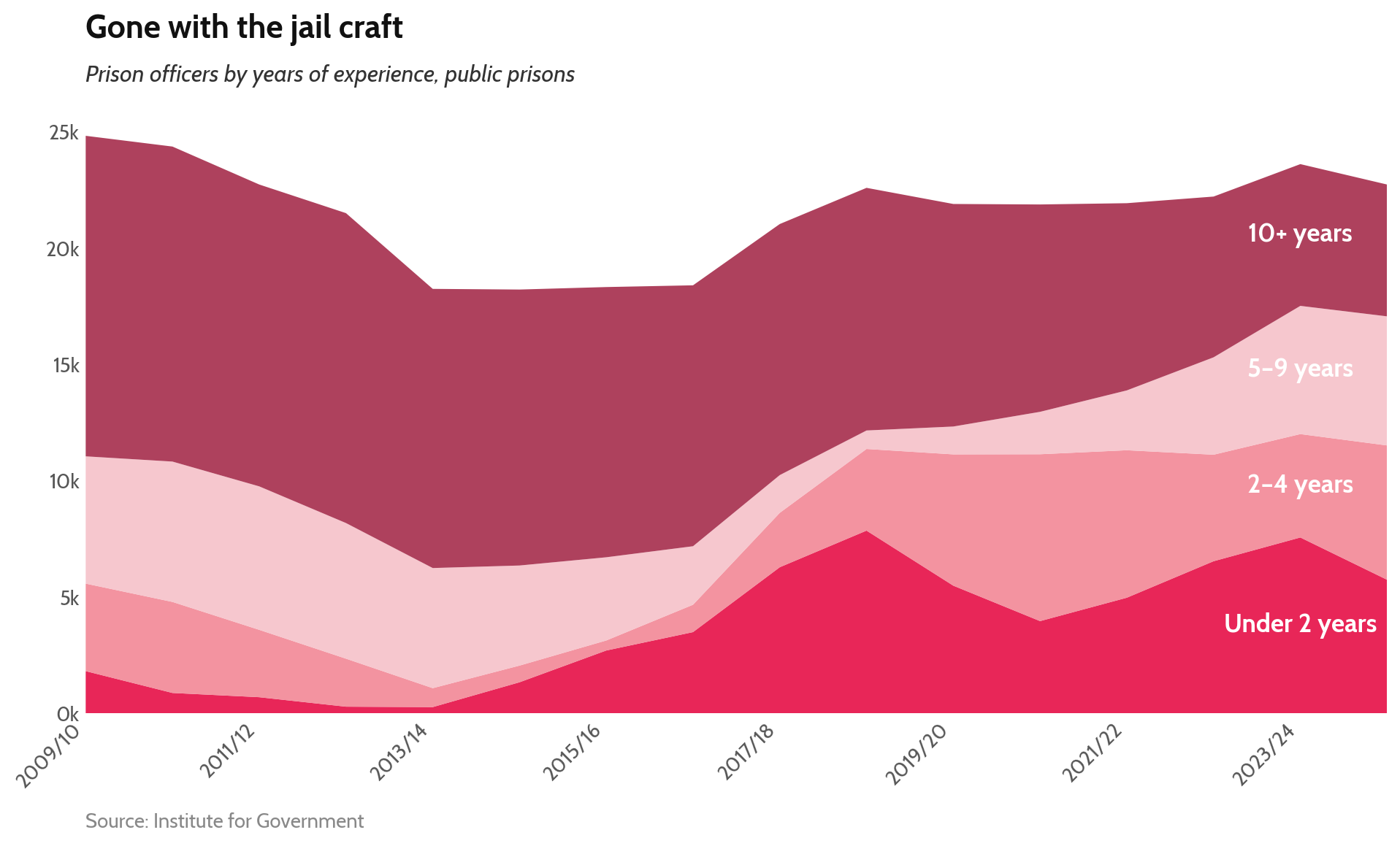
Similarly prison officers talk of “jail craft”, the knack of managing fraught relationships with prisoners with your tongue rather than your taser, as a skill which takes a decade to build. In 2010, more than half of prison officers had that level of experience. Now less than a quarter do (see chart). As experience left, Britain’s prisons became more chaotic. The more chaotic they were, the more difficult it became to hire, train and keep new prison officers. Offender outcomes tanked; rates of self-harm and violence soared.
As with resident doctors, topping up pay back up to what it was in 2010 will not be enough to repair what was broken. For one, it has already happened, and it hasn’t worked. Austerity created scar tissue which requires deeper treatment.
So, what should Labour do? The big task is to rebuild public service jobs back to being vocations– jobs which people take purpose from and pride in, not just a payslip.
Rungs on the ladder
In prisons, the government probably does need to spend more on pay – the recent chaos will have structurally raised the amount it takes to persuade someone to be a prison officer, who are now three times as likely to be assaulted at work. The current alternative, recruiting from overseas to avoid raising wages, is not a sustainable solution in a job where communication skills are so vital to doing it well. The job of a prison officer risks being reduced from a life’s endeavour to a stopgap for those who can’t find something better.
But more broadly, enabling better career progression will get Labour more bang for its buck than further boosting starting salaries. Seeing the rungs on the ladder you could climb is a crucial attraction of any vocation. People need to feel if they work hard and do well, they can get on–a belief diluted by the Tories. There still are a third fewer senior roles in prisons than there were in 2010. Many prison governors earn less than head teachers, and often have much less say over how things are run.
In the NHS, where resident doctors now compete fiercely for training posts due to Tory mismanagement, and many doctors now face the possibility of getting no training post at all, making more posts available will do more to quell future strikes than another payrise.
Rebuilding vocations will also require the government to put its money towards perks, not just pay. Ask a prison officer where they ate their lunch yesterday, and in all likelihood they will tell you it was in their car. As space ran short, the prison service converted staffrooms into make-shift cells. How many prison officers looked into their rear-view mirror and decided a life working in prisons wasn’t for them? Enough for us to regret, I am sure.